You got your windshield replaced, you drove away, and everything seemed fine. The glass looked great. The shop did the job in under two hours. But a week later, your lane departure warning starts behaving strangely — alerting when you’re clearly centered in your lane, or failing to alert when you drift. Or your automatic emergency braking system throws a fault warning on the dashboard.
This isn’t a rare fluke. It’s a predictable consequence of windshield replacement in vehicles equipped with Advanced Driver Assistance Systems (ADAS) when camera or sensor calibration isn’t done correctly afterward. And it’s a more common situation than most New England drivers realize — because the ADAS adoption curve has been steep, and not every shop has kept up.
As of 2023, the Insurance Institute for Highway Safety (IIHS) reported that forward collision warning systems, automatic emergency braking, and lane departure warning are now standard or widely available on the majority of new passenger vehicles sold in the U.S. In Connecticut, Massachusetts, and Rhode Island — markets where newer vehicles tend to skew higher given household income levels and a strong preference for safety-rated models — a significant percentage of vehicles on the road today have at least one windshield-mounted camera or sensor.
Here’s what you need to know as a driver before, during, and after windshield replacement.
Why the Windshield Matters to Your Safety Systems
Most drivers think of the windshield as glass that keeps the wind and rain out. In newer vehicles, it’s also a precision mounting surface for technology. The forward-facing camera that enables features like automatic emergency braking (AEB), lane departure warning (LDW), lane keeping assist (LKA), traffic sign recognition, and adaptive cruise control is almost universally mounted at or just behind the windshield — typically near the rearview mirror.
That camera needs to be pointed in a very specific direction and at a very specific angle to function correctly. The calibration process — which can be either ‘static’ (done in a controlled shop environment using target boards) or ‘dynamic’ (done by driving the vehicle on a road at specific speeds while a computer reads sensor output) — sets those parameters precisely. According to SAE International, even a fraction of a degree of misalignment in a forward-facing camera can cause meaningful errors in how the system detects lane markings, vehicles ahead, or obstacles.
When you replace a windshield, even a perfect installation introduces variation. The new glass sits at a slightly different position than the original. The mounting bracket for the camera may need to be reattached. The relationship between the camera and the road changes — and without recalibration, the system is operating on assumptions that are no longer accurate.
What Goes Wrong When Calibration Is Skipped
The consequences of skipping ADAS recalibration range from annoying to dangerous, depending on what system is affected and how far the calibration is off.
On the annoying end: false alerts. Your lane departure warning beeps constantly, even when you’re driving normally. Your automatic emergency braking engages unexpectedly when approaching an overpass. These are real things that happen, and they’re not just inconvenient — they erode driver trust in the safety systems and can lead people to disable them entirely.
On the dangerous end: missed alerts. A miscalibrated forward collision warning may fail to detect a stopped vehicle until it’s too late for automatic braking to be effective. The IIHS has published research showing that properly functioning AEB systems can reduce rear-end crashes by 50% or more. A miscalibrated system may provide little to no protection — while the driver believes the safety net is intact.
Radar-based systems for adaptive cruise control and blind spot monitoring — often housed in mirrors, bumpers, or grille areas rather than the windshield — are less directly affected by glass replacement. But if your vehicle has any windshield-mounted technology at all, calibration is not optional.
How to Know If Your Car Has Windshield-Mounted ADAS
Not sure whether your vehicle has a camera mounted on the windshield? Here’s how to check:
- Look at the interior of your windshield near the rearview mirror. Most forward-facing cameras sit behind a small housing or bracket that clips to the glass or the headliner near the mirror base.
- Check your owner’s manual for any mention of forward collision warning, lane departure warning, automatic emergency braking, traffic sign recognition, or adaptive cruise control. If your car has any of these features, it almost certainly has a windshield-mounted camera.
- Look up your vehicle on the IIHS website — their vehicle ratings pages list which driver assistance features are standard or available for each model year.
- When in doubt, ask your auto glass shop before they begin work. A knowledgeable shop will be able to tell you immediately whether your vehicle’s make, model, and year requires post-replacement calibration.
Static vs. Dynamic Calibration: What’s the Difference?
There are two types of ADAS camera calibration used after windshield replacement, and vehicle manufacturers specify which one applies to each make and model.
Static calibration is done in the shop with the vehicle parked and stationary. Technicians use specialized target boards positioned at specific distances and angles from the vehicle, and calibration software guides the process to align the camera parameters. Static calibration requires a level surface, specific lighting conditions, and accurate positioning of the targets — quality shops invest in the right equipment to do this correctly.
Dynamic calibration requires driving the vehicle for a set distance on roads that meet specific conditions — usually a highway or well-marked road with clear lane markings — while the system’s onboard computer reads sensor input and self-adjusts. Some manufacturers require a combination of both.
The specific calibration type required for your vehicle is determined by the manufacturer, not the shop. Resources like the Auto Glass Safety Council’s calibration database help technicians identify the correct procedure for each vehicle. When you bring your car in, your shop should be able to tell you which type of calibration your vehicle requires and whether they perform it in-house or coordinate with a dealer or specialty calibration service.
Questions to Ask Your Auto Glass Shop Before You Book
Not all shops are equally equipped for ADAS work. The quality and training level of your technician matter a lot. Here are the questions worth asking before you schedule:
- Does my vehicle require ADAS recalibration after windshield replacement, and do you perform it in-house?
- What calibration equipment do you use, and is it manufacturer-approved for my vehicle make and model?
- Is calibration included in the replacement quote, or is it a separate cost?
- If calibration is done separately, who performs it and how soon after glass replacement?
- Do you provide documentation of the calibration results?
A shop that’s comfortable with these questions and gives clear answers takes ADAS seriously. If you get vague responses or the question seems unexpected, that’s worth noting.
New England Roads and ADAS: A Particular Challenge
It’s worth noting that ADAS systems, in general, face specific challenges in New England driving conditions — and understanding these can help you recognize when your system is behaving as designed vs. when something may be off after glass service.
Lane departure warning systems depend on clear lane markings. In Connecticut, Rhode Island, and Massachusetts, road markings can be faded on older secondary roads, obscured by sand and salt residue in late winter, or temporarily absent in construction zones. A calibrated system may still issue false alerts in these conditions — that’s the system doing its job with imperfect input, not a malfunction.
Snow and ice accumulation on or near the windshield can also interfere with camera function. AAA research has found that ADAS performance degrades significantly in heavy rain, snow, and fog — all common in the New England driving year. Keeping your windshield clear of accumulation and ensuring your wipers are in good condition directly supports the performance of your safety systems.
Payless Auto Glass: ADAS-Ready Service in CT, RI, and MA
At Payless Auto Glass, our technicians are trained to identify ADAS requirements for the vehicles we service and to advise customers on calibration needs before and after replacement. We serve drivers across Connecticut, Rhode Island, and Massachusetts with seven locations and mobile service.
If your vehicle has a forward-facing camera, rain sensor, heated windshield, or other embedded technology, tell us when you call — we’ll make sure the right services are included in your appointment. For a free quote, call 877-776-4527 or get your instant quote here.
Frequently Asked Questions
Q: My car is only three years old. Does it definitely need ADAS calibration after windshield replacement?
A: If your vehicle was manufactured in the last four to five years, there is a very high probability it has at least one windshield-mounted camera. The surest way to know is to check the area near your rearview mirror for a camera housing, or review your owner’s manual for any driver assistance features. When in doubt, ask your shop to confirm before work begins.
Q: Can I drive my car before ADAS calibration is done?
A: Yes — the vehicle will drive normally. But your ADAS features may not function correctly until calibration is complete and, in some cases, may display a warning light or error message. If calibration can’t be done immediately after replacement, turn off your driver assistance features, or be aware that they may not be fully operational until the process is finished.
Q: Will my insurance cover ADAS calibration as part of a windshield replacement claim?
A: It depends on your policy. Many comprehensive auto insurance policies now cover ADAS recalibration as part of a glass claim, but this is not universal. When you file your claim, ask specifically whether calibration is covered. Your shop can also help document the calibration requirement for the claim. Connecticut’s zero-deductible glass law covers the glass replacement; calibration coverage depends on policy terms.
Q: How long does ADAS calibration take?
A: Static calibration typically adds 30 minutes to an hour to the glass replacement appointment when done in-house. Dynamic calibration requires a road drive of varying length, depending on the manufacturer’s specifications — usually 20 to 40 minutes. Some vehicles require both, which extends the total service time accordingly.
Q: I had my windshield replaced at a national chain last year, and they never mentioned calibration. Should I be worried?
A: If your ADAS features are working correctly — no dashboard warning lights, no unusual false alerts, no failure to alert in situations where you’d expect a response — the calibration may have been done, may have been self-calibrated during driving, or your vehicle may not have required it. If you have any concerns, bring your vehicle to a shop that can calibrate ADAS and have them verify that the system is functioning within spec.
Q: Does glass type affect ADAS camera performance?
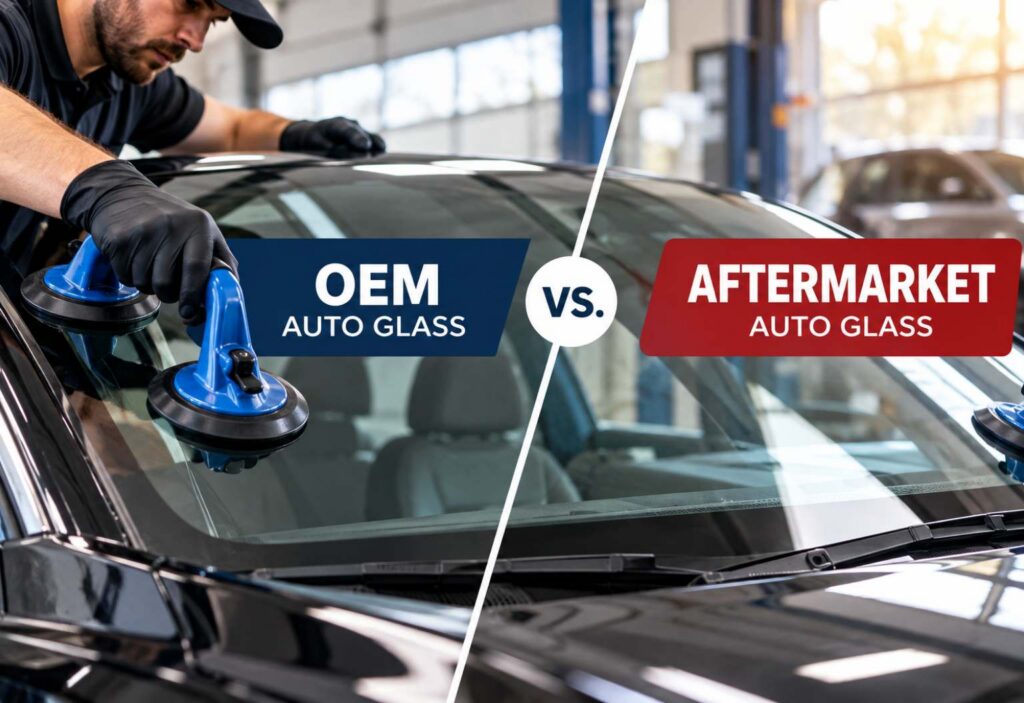
A: Yes, potentially. Some ADAS cameras are designed to work with specific glass specifications, particularly around acoustic glass, UV-filtering coatings, or heating elements embedded in the glass. Using non-OEM glass that doesn’t match those specifications can affect camera performance even after calibration. Quality aftermarket glass that meets AGSC/ANSI/SAE Z26.1 standards is designed to be compatible with ADAS systems, but it’s a fair question to raise with your shop when specifying the replacement glass.
Sources: Insurance Institute for Highway Safety (IIHS) | SAE International | Auto Glass Safety Council | AAA ADAS Research | NHTSA