If you manage a fleet — whether it’s a dozen delivery vans, a team of service vehicles, a municipal pool of public works trucks, or a dealership’s loaner fleet — you already know that keeping vehicles operational and compliant is a constant job. Auto glass probably isn’t the first thing on your checklist. It should be closer to the top.
Cracked or damaged windshields create real liability exposure, can put vehicles out of DOT compliance, affect driver safety, and lead to costly emergency replacements when a small chip would have been a simple fix. Across Connecticut, Rhode Island, and Massachusetts, fleet managers who build a proactive glass maintenance strategy into their operations save money and avoid headaches. Here’s what you need to know.
The DOT Compliance Problem Nobody Talks About
Federal Motor Carrier Safety Administration (FMCSA) regulations under 49 CFR Part 393.60 require that windshields on commercial motor vehicles be free of disqualifying damage. Specifically, the regulations prohibit cracks, discoloration, or other damage in the area swept by the driver’s side windshield wiper that would impair the driver’s view.
What qualifies as ‘disqualifying damage’ under the federal standard: a crack that intersects another crack (creating an X pattern), damage in the critical vision area greater than a specific size, and any condition that obstructs the driver’s view in the primary sight zone. Violations discovered during a roadside inspection can result in the vehicle being placed out of service immediately, which means a driver stranded on the side of I-95 and a delivery or service call that doesn’t happen.
Connecticut, Rhode Island, and Massachusetts each conduct their own commercial vehicle inspections in addition to federal enforcement. The Connecticut Department of Motor Vehicles, Rhode Island Division of Motor Vehicles, and Massachusetts Registry of Motor Vehicles all have the authority to conduct inspections and require vehicles to meet glass condition standards.
The risk is real. A fleet manager whose driver gets placed out of service for a cracked windshield during a roadside check faces not just the cost of the replacement, but lost productivity, a tow if necessary, and a potential flag in the company’s safety rating — all for damage that a $50 chip repair might have prevented weeks earlier.
Building an Inspection Protocol That Actually Works
The most effective fleet glass programs don’t wait for problems to become urgent — they find damage early through consistent inspection habits. Most fleet managers already have pre-trip inspection requirements in their DOT compliance programs, but the condition of glass is often treated as a pass/fail checkbox rather than as something to document and track.
A more rigorous approach:
- Require drivers to report any glass damage — including chips smaller than a quarter — at the end of every shift, not just during formal pre-trip inspections.
- Create a simple photo documentation process: if a driver notices damage, they photograph it with their phone and log it in whatever fleet management system you use. Timestamps matter if there’s ever a dispute about when damage occurred.
- Set a repair threshold: any chip smaller than a dollar bill gets repaired within 48 hours. Any crack longer than six inches gets the vehicle scheduled for replacement within one week. Don’t let borderline damage sit.
- Review glass condition as part of your regular preventive maintenance cycle — not just when something is visibly wrong.
- Track repair and replacement history by vehicle. A vehicle that’s had three windshields in two years may have a route problem, a driver behavior issue, or be positioned in a way that exposes it to more debris than others.
The True Cost of Emergency Replacements vs. Planned Service
Fleet managers who deal with glass reactively — only acting when a windshield is broken, or a vehicle fails inspection — consistently pay more than those with a proactive program. The math is straightforward.
Chip repair, when done early, typically costs $50 to $100 per chip and takes less than an hour. According to data from the National Windshield Repair Association (NWRA), a properly repaired chip has a 95% or better success rate and can extend the life of the windshield indefinitely. Compare that to a full windshield replacement, which for commercial vehicles runs from several hundred to well over $1,000, depending on the vehicle, glass type, and whether any embedded technology requires calibration.
Beyond the direct cost difference, there’s the productivity factor. A planned replacement can be scheduled for overnight or during a known downtime window. An emergency replacement — triggered by a chip that finally ran across the windshield, or a vehicle pulled from service during an inspection — removes a vehicle from your rotation during operational hours.
For fleets of 10 or more vehicles, the difference between reactive and proactive glass management can easily run into thousands of dollars per year.
Understanding Your Insurance Options for Fleet Glass
Commercial fleet insurance in Connecticut, Rhode Island, and Massachusetts typically includes glass coverage as part of a comprehensive policy, but the terms vary widely depending on your carrier, fleet size, and policy structure.
A few questions worth raising with your commercial insurance broker:
- Is there a per-vehicle glass deductible, or does your policy include zero-deductible glass coverage? Connecticut’s mandatory zero-deductible glass law applies to personal auto policies — commercial fleet policies are often structured differently and may not carry the same protections.
- Does your policy cover chip repair, or only full replacement? Some commercial policies only trigger at the replacement threshold.
- Is ADAS recalibration covered as part of a windshield replacement claim? As more fleet vehicles include cameras, radar, and sensors mounted near the glass, this coverage question is increasingly important.
- Do you have a preferred vendor arrangement that affects which shops you can use? You may have more flexibility than you think.
Working with a regional glass provider rather than a national chain can also give fleet managers more flexibility on scheduling, billing arrangements, and priority service, which matters when you need a vehicle back in rotation quickly.
ADAS and Fleet Vehicles: A Growing Consideration
Newer commercial vehicles increasingly come equipped with driver assistance technology — forward collision warning, lane departure alerts, automatic emergency braking, and backup cameras. Many of these systems use cameras or sensors mounted at or near the windshield. When a windshield is replaced, those systems often require recalibration to function correctly.
The Insurance Institute for Highway Safety (IIHS) has documented cases where improperly calibrated ADAS systems failed to function as intended after glass service. For fleet managers, this creates both a safety obligation and a liability consideration — particularly for vehicles operating under DOT safety program requirements.
When evaluating glass service providers for your fleet, ask explicitly whether they are equipped to perform ADAS recalibration and whether that service is included or available for your specific vehicle types. Not all shops have this capability, and it’s a meaningful differentiator.
Why Regional Providers Make Sense for New England Fleets
National auto glass chains have their place, but fleet managers across Connecticut, Rhode Island, and Massachusetts often find that regional providers are better partners for their specific needs. Regional shops understand the local road conditions — the pothole-heavy spring thaws that send chips flying from highway surfaces, the summer construction season on I-95 and Route 1, the salt spray from coastal routes in southeastern Massachusetts and Rhode Island. They’re also typically more flexible on scheduling, more responsive on urgent calls, and more willing to build a custom service arrangement for accounts with consistent volume.
A regional provider with multiple locations across the tri-state service area can handle vehicles at whichever location is most convenient, coordinate billing efficiently, and offer mobile service for vehicles that can’t easily be brought to a shop.
Payless Auto Glass: A Fleet Partner Across CT, RI, and MA
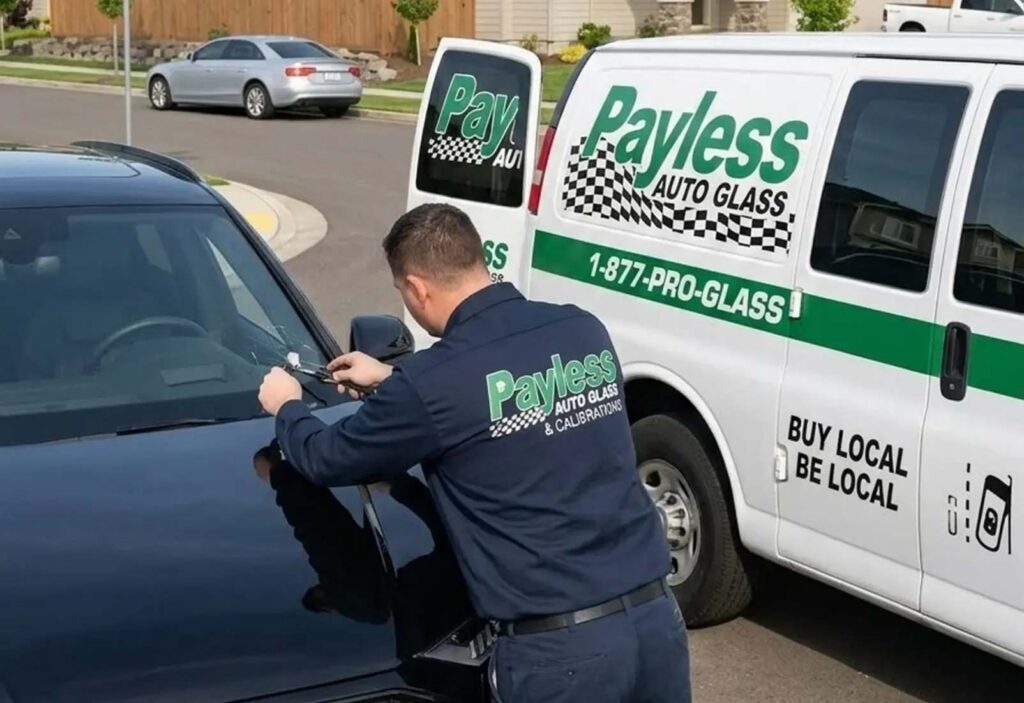
Payless Auto Glass has been serving fleet accounts throughout Connecticut, Rhode Island, and Massachusetts for years. We work with delivery operators, auto dealerships, municipal fleets, property management companies, and service businesses of all sizes. Our seven locations — plus mobile service — mean we can handle your vehicles where and when it’s most convenient.
We offer dedicated fleet account management, direct insurance billing, and ADAS recalibration services for vehicles that require it. To discuss a fleet glass program for your organization, contact us at paylessautoglass.com or call 877-776-4527 for a free consultation.
Frequently Asked Questions
Q: Does Connecticut’s zero-deductible glass law apply to commercial fleet vehicles?
A: Connecticut’s mandatory zero-deductible glass statute (CGS §38a-354) applies to personal automobile insurance policies. Commercial fleet policies are governed by different rules and may or may not include zero-deductible glass coverage depending on how the policy is written. Review your commercial policy specifically with your broker.
Q: What qualifies as a DOT windshield violation during a roadside inspection?
A: Under 49 CFR Part 393.60, disqualifying windshield damage includes any crack that intersects another crack, damage in the driver’s critical vision area that impairs sight, and missing or dislocated glass. A vehicle found in violation can be placed out of service on the spot. The full regulation is available at the eCFR.
Q: How often should fleet vehicles have their glass formally inspected?
A: At a minimum, glass condition should be part of every pre-trip inspection under your DOT compliance program. For more proactive management, a monthly formal inspection by a trained technician — either in-house or by a service provider — is a reasonable standard for fleets with high mileage or heavy highway exposure.
Q: Can fleet glass service be billed directly to our insurance company?
A: Yes, in most cases. Payless Auto Glass works directly with commercial insurers and can handle the billing process for eligible claims. The specifics depend on your policy structure and insurer. We recommend having your fleet account set up before damage occurs, so the process is seamless when you need it.
Q: My fleet includes newer vehicles with cameras on the windshield. Does replacement always require recalibration?
A: Not always — it depends on the specific vehicle and ADAS configuration. However, many vehicles with forward-facing cameras, rain sensors, or other windshield-mounted technology do require calibration after glass replacement. We assess each vehicle individually and advise on what’s required. Never assume recalibration isn’t needed without confirming with a trained technician.
Q: We operate in all three states — CT, RI, and MA. Can Payless handle our entire fleet?
A: Yes. Payless Auto Glass serves all three states with multiple locations and mobile service. We can coordinate service across your fleet, regardless of where individual vehicles are based or which routes they run. Contact us to discuss a multi-location fleet account arrangement.
Sources: FMCSA 49 CFR Part 393.60 | National Windshield Repair Association | IIHS | CT DMV | RI DMV | MA RMV