What every New England driver with a modern vehicle needs to understand before getting glass work done
There was a time when replacing a windshield was a straightforward job. Remove the old glass, prep the frame, set the new glass, let the adhesive cure, and send the customer on their way. For many older vehicles, it’s still that simple.
But if your car was built in the last decade — and especially if it has features like automatic emergency braking, lane departure warning, or adaptive cruise control — windshield replacement involves one more critical step that a surprising number of drivers (and even some shops) don’t know about: ADAS calibration.
Skipping it isn’t just an oversight. It can mean that the safety systems your vehicle depends on are operating on bad data, pointing in the wrong direction, or not functioning at all. Here’s what you need to know.
What Is ADAS?
ADAS stands for Advanced Driver Assistance Systems — the collection of active safety technologies that have become standard on most new vehicles sold in the United States. These include:
- Automatic Emergency Braking (AEB)
- Lane Departure Warning and Lane Keep Assist
- Adaptive Cruise Control
- Forward Collision Warning
- Traffic Sign Recognition
- Pedestrian Detection
According to the Insurance Institute for Highway Safety (IIHS), vehicles equipped with front camera-based systems show significantly reduced rates of rear-end crashes and pedestrian fatalities. These aren’t luxury features anymore — the National Highway Traffic Safety Administration (NHTSA) has made AEB a requirement on all new passenger vehicles starting with the 2029 model year, and many automakers have already adopted it as standard across their lineups.
The camera that powers most of these systems is typically mounted on a bracket behind the rearview mirror, looking forward through the windshield. That location — right up against the glass — is exactly what creates the calibration issue.
Why Windshield Replacement Affects Calibration
When a windshield is replaced, the camera doesn’t move — but its relationship to the glass does. Even if a technician is extraordinarily careful, the new windshield will sit in the frame at a marginally different angle than the original. The adhesive thickness, the glass tolerances, and the installation technique all introduce variables measured in fractions of a millimeter.
That might sound trivial, but the ADAS camera is interpreting those fractions of a millimeter as angular differences in what it sees. A camera that’s off by one degree of tilt will misread lane markers, miscalculate the distance to vehicles ahead, and trigger (or fail to trigger) automatic braking at the wrong moment.
The Society of Automotive Engineers (SAE) has published guidance stating that even minor camera misalignment after glass replacement can cause ADAS systems to operate outside their designed performance parameters. Several automakers — including Honda, Subaru, Toyota, and Volvo — explicitly require recalibration after any windshield replacement as a condition of maintaining the vehicle’s safety system warranty.
Static vs. Dynamic Calibration: What’s the Difference?
Calibration isn’t a single standard procedure — it comes in two forms, and the type your vehicle requires depends on the make, model, and year.
Static calibration is performed in a controlled environment, typically indoors, using specialized targets placed at precise distances and angles in front of the vehicle. The technician uses manufacturer-specific software to align the camera to those targets and reset its reference points. This process requires a flat, level surface and specific spatial requirements — not something that can be done in a driveway.
Dynamic calibration is performed while driving. After the windshield is replaced, a technician drives the vehicle on a road that meets specific requirements (typically a well-marked highway at a set speed) while the vehicle’s software uses real-world input to recalibrate the camera. Some vehicles require a combination of both.
The OEM Calibration Reference Guide published by the Auto Glass Safety Council catalogs recalibration requirements by make and model. It’s the reference document that qualified auto glass technicians use to determine what your specific vehicle needs. If a shop doesn’t consult it — or doesn’t know it exists — that’s worth noting.
What Happens If You Skip It
This is where things get serious. A miscalibrated ADAS camera doesn’t necessarily trigger a dashboard warning light. The system may appear to be functioning normally while actually operating outside of spec.
In practical terms, that can mean automatic emergency braking that fires too late — or not at all. Lane keep assist that pulls the vehicle in the wrong direction. Adaptive cruise control that misjudges the distance to the vehicle ahead. These aren’t hypothetical scenarios. The IIHS has documented real-world performance degradation in ADAS systems following improper glass replacement.
There’s also a liability dimension. If your vehicle is involved in an accident and it’s determined that the ADAS system was miscalibrated following a windshield replacement, that could affect your insurance claim and potentially your legal exposure. The paper trail matters.
What to Ask Your Auto Glass Provider
Before any windshield replacement, these are the questions worth asking:
- Does my vehicle require ADAS recalibration after windshield replacement? (The answer for most post-2015 vehicles with forward-facing cameras is yes.)
- Do you perform calibration in-house or subcontract it?
- What calibration equipment and software do you use?
- Will you provide documentation confirming calibration was completed?
A shop that performs calibration in-house using OEM-approved equipment and software is preferable to one that sends the vehicle out to a third party — not because subcontractors can’t do good work, but because the chain of responsibility is cleaner and the timeline is shorter.
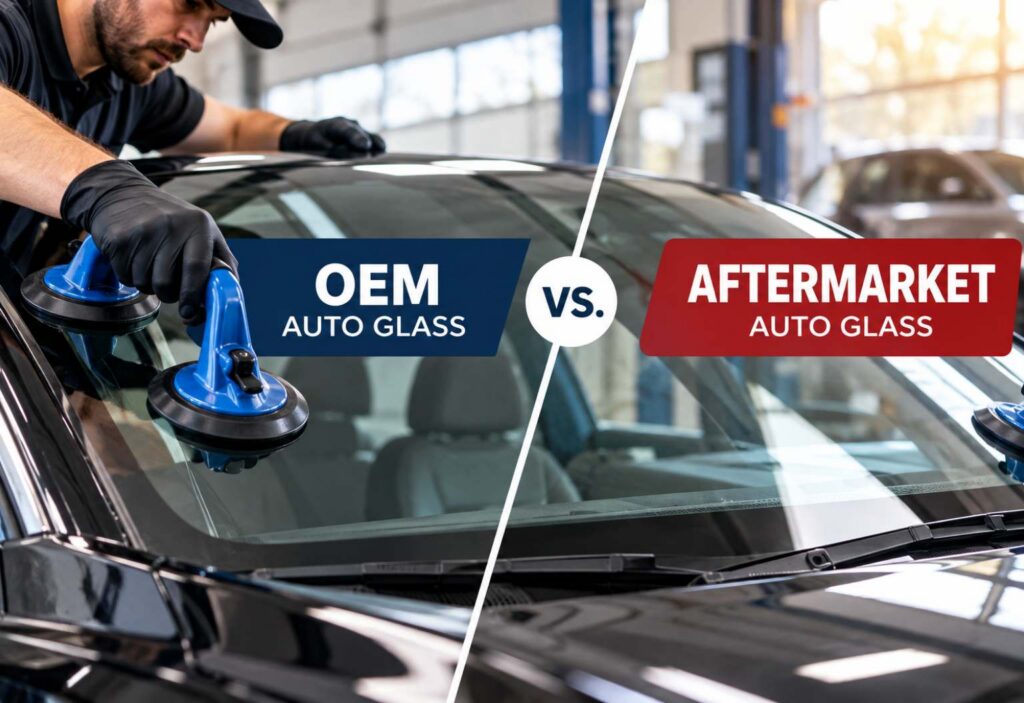
It’s also worth confirming that the replacement glass itself is compatible with your ADAS system. Some forward-facing cameras require windshields with specific acoustic or optical properties — particularly those in vehicles with acoustic glass or solar-reflective coatings. Using an incompatible glass can affect calibration results regardless of how carefully the procedure is performed.
The New England Context
New England drivers replace windshields at a higher rate than most of the country. The combination of harsh winters, aggressive road salting, freeze-thaw pothole cycles, and dense traffic on aging highway infrastructure creates more chips, more cracks, and more glass replacements per vehicle per year than warmer, drier regions.
At the same time, vehicle technology has advanced rapidly. A driver in Massachusetts or Connecticut who replaced a windshield five years ago on a basic sedan may not realize that their new crossover or pickup truck has a forward camera system that requires calibration. The awareness gap is real, and it’s worth closing.
According to AAA research on ADAS technology, a significant percentage of drivers with ADAS-equipped vehicles are unaware of how those systems work or what maintenance they require. That’s not a criticism — the technology evolved faster than consumer education kept pace. But it does put the burden on drivers to ask the right questions.
About Payless Auto Glass
Payless Auto Glass understands that windshield replacement in today’s vehicles is about more than the glass. The team is certified, trained and equipped to perform ADAS recalibration — both static and dynamic — as part of the replacement process on vehicles that require it.
Serving drivers across New England, Payless Auto Glass uses manufacturer-approved calibration software and documents the process so you have a record of the work performed. Whether your vehicle is a late-model SUV with a full suite of driver assistance features or an older car that needs a straightforward replacement, Payless Auto Glass handles it with the same attention to detail.
Contact Payless Auto Glass to schedule your windshield replacement and find out whether your vehicle requires ADAS recalibration — it could be the most important part of the job.
Frequently Asked Questions
Q: How do I know if my vehicle has ADAS?
A: Check your owner’s manual under “safety features” or “driver assistance systems.” If your vehicle has automatic emergency braking, lane departure warning, or adaptive cruise control, it almost certainly has a forward-facing camera that requires recalibration after windshield replacement. You can also look for a camera mounted at the top of the windshield behind the rearview mirror — if you see one, recalibration is required.
Q: How much does ADAS calibration cost?
A: Static calibration typically runs between $150 and $400 depending on the vehicle. Dynamic calibration is generally less expensive on its own but may need to be combined with static calibration for some vehicles. Many auto glass providers bundle calibration into the replacement quote. Check whether your insurance covers it — comprehensive policies increasingly include recalibration as part of glass replacement coverage.
Q: Can the dealership do the calibration instead of the glass shop?
A: Yes, dealerships can perform calibration, and for some complex or rare vehicles that may be the best option. However, a qualified auto glass specialist with the appropriate equipment can perform the same procedure at typically lower cost and with faster turnaround. The key is confirming they use OEM-approved software for your specific vehicle make and model.
Q: My car didn’t show any warning lights after the replacement. Does that mean calibration isn’t needed?
A: Not necessarily. Many ADAS systems don’t self-detect calibration errors the way a mechanical fault triggers a warning light. The camera continues to operate — it just operates on incorrect reference data. The absence of a warning light is not confirmation that the system is functioning correctly.
Q: Does insurance cover ADAS recalibration?
A: Increasingly, yes. Many comprehensive auto insurance policies now explicitly include ADAS recalibration as a covered component of windshield replacement. Coverage varies by insurer and policy, so it’s worth confirming directly. Payless Auto Glass can assist with the insurance process and help clarify what’s covered under your specific policy.
Q: Is recalibration required for a windshield repair, or only replacement?
A: For a repair — where the original glass is retained and resin is injected — recalibration is generally not required, since the camera’s position relative to the glass hasn’t changed. Recalibration is specifically triggered by removal and replacement of the windshield itself.
References: Insurance Institute for Highway Safety — iihs.org | NHTSA Automated Vehicles Safety — nhtsa.gov | Society of Automotive Engineers — sae.org | Auto Glass Safety Council ADAS Resources — agsc.org/adas | AAA ADAS Research — newsroom.aaa.com