If you drive in Connecticut and have comprehensive auto insurance, there’s a good chance you’re entitled to a completely free windshield replacement — and you may not even know it. Connecticut is one of only three states in the country that mandates zero-deductible coverage for auto glass repair and replacement under comprehensive policies. That means no out-of-pocket cost to you, no matter what your deductible is for other types of claims.
Yet every week, drivers across Hartford, New Haven, Bridgeport, and beyond pay for services they don’t need to — either because their insurer didn’t volunteer the information or because they simply didn’t know to ask. This article breaks down exactly what the law says, how it compares to neighboring Rhode Island and Massachusetts, and what you need to do to take advantage of what you’re already paying for.
What Connecticut Law Actually Says
Connecticut General Statutes Section §38a-354 requires that any auto insurance policy issued in the state that includes comprehensive coverage must also provide coverage for the repair or replacement of automobile glass with no deductible applied. The law has been in place for decades and is among the strongest consumer protections in the country for auto glass.
What this means in practice: if a rock kicks up on I-84 and cracks your windshield, or a branch falls on your car during a storm and shatters the rear glass, your insurance company is required by law to cover the full cost of repair or replacement — even if your comprehensive deductible is $500 or $1,000.
There’s no claim filing trick or special form. You simply contact your insurer, file a glass claim under your comprehensive coverage, and the work gets done at no cost to you. Connecticut does not allow insurers to raise your premiums specifically because you filed a glass claim, either, though this area of the law is worth confirming with your specific carrier.
Rhode Island and Massachusetts: Different Rules, Important Distinctions
Connecticut’s law is unusually strong. Neighboring states take different approaches, and it’s worth understanding the contrast — especially if you live near a border or have recently moved to the region.
Rhode Island does not have a mandatory zero-deductible glass law. Drivers in Providence, Warwick, and across the state are subject to whatever deductible they’ve agreed to in their policy. Some insurers voluntarily offer low or zero-deductible glass endorsements, but they’re not required to. If you’re a Rhode Island driver, it’s worth calling your insurance agent specifically to ask about your glass coverage terms — don’t assume.
Massachusetts sits somewhere in between. The state’s Division of Insurance regulates auto glass coverage, and while comprehensive coverage is required if you finance or lease a vehicle, the glass-specific zero-deductible mandate does not exist as it does in Connecticut. Massachusetts drivers should review their auto insurance policy details and ask explicitly about glass deductibles.
Bottom line: if you’re a Connecticut driver, you’re in the best position of the three states. If you’re in RI or MA, you need to know what your policy says before your windshield cracks.
Why Drivers Still End Up Paying — And How Insurers Get Away With It
Despite the law’s clarity, many Connecticut drivers still end up paying out of pocket for windshield work. There are a few reasons this happens.
First, some drivers simply don’t know the law exists. Insurers are not obligated to proactively remind you about this benefit every time you renew your policy, and the information isn’t always prominently displayed in your declarations page or online account.
Second, some shops — particularly national chain operations — may steer the conversation toward your deductible before clarifying whether a zero-deductible glass claim applies. If you don’t push back, you might pay anyway.
Third, there’s the question of which shops are on your insurer’s preferred vendor list. Companies like Safelite have negotiated preferred provider arrangements with many major insurers. While you generally have the legal right to choose your own shop in Connecticut (this is protected under consumer choice principles), insurers may not volunteer that information. It’s worth asking your agent directly: ‘Can I use any licensed auto glass shop in Connecticut?’
The answer, in most cases, is yes.
How to File a Zero-Deductible Glass Claim in Connecticut
The process is simpler than most people expect. Here’s how it works:
- Call your insurance company’s claims line or log into your online account and select ‘glass claim’ or ‘comprehensive claim for glass damage.’
- Tell them you are filing under Connecticut’s zero-deductible glass law. Use that specific language — it helps.
- Choose your repair shop. You are entitled to select a licensed auto glass shop of your choosing.
- The shop will coordinate directly with your insurer for payment. In most cases, you won’t see a bill.
- The work is scheduled and completed. For most passenger vehicles, windshield replacement takes 1–2 hours. Mobile service is often available.
One practical note: small chips can often be repaired rather than replaced, which is faster and costs your insurer less. If your damage is a single chip smaller than a quarter, ask whether repair is an option — it preserves your original factory glass and typically carries a shorter wait time.
What About Aftermarket vs. OEM Glass?
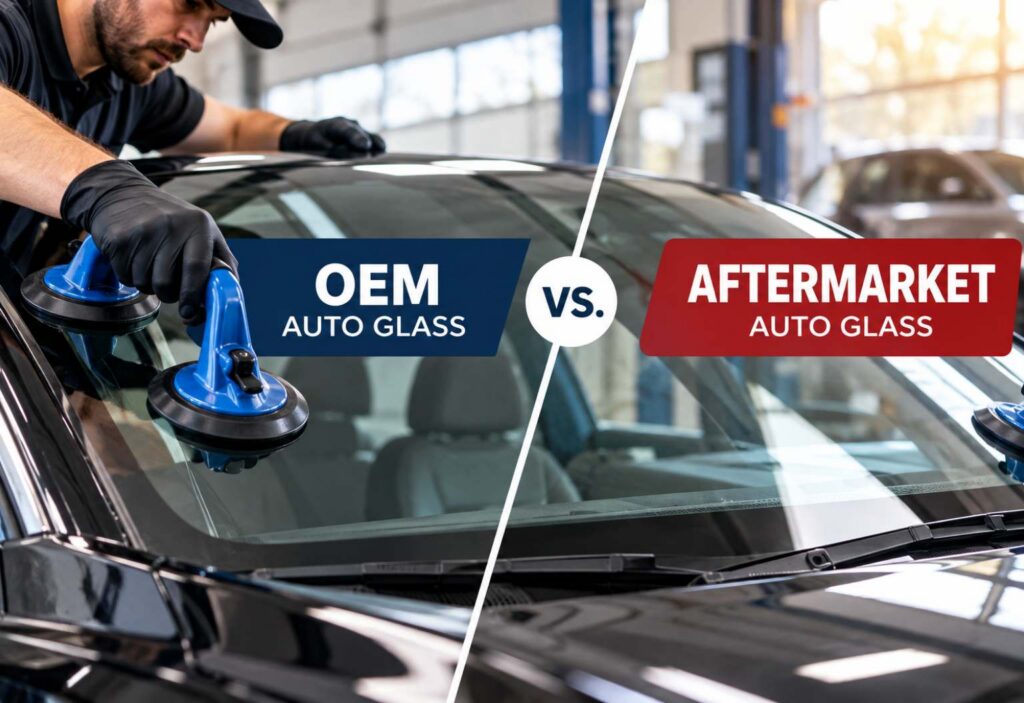
When your windshield is replaced under an insurance claim, your insurer may specify the use of aftermarket glass rather than OEM (Original Equipment Manufacturer) glass. This is a legitimate conversation to have — and the Auto Glass Safety Council (AGSC) has established standards (ANSI/SAE Z26.1) that quality aftermarket glass must meet.
If your vehicle has advanced driver assistance systems (ADAS) — features like lane departure warning, automatic emergency braking, or forward collision alert — the type of glass used may affect camera and sensor calibration. Ask your shop whether the replacement glass is AGSC-certified and whether ADAS recalibration is included in the work.
Payless Auto Glass: Your Local Connecticut Specialist
At Payless Auto Glass, we work directly with all major insurance carriers to handle the zero-deductible glass claim process on your behalf. Our customers in Hartford, Hamden, Fairfield, Norwich, and across Connecticut don’t have to navigate the paperwork — we do it for them.
We service all makes and models, carry AGSC-certified glass, and offer mobile service throughout Connecticut, Rhode Island, and Massachusetts. If your windshield has a crack, chip, or break, call us for a free quote: 877-776-4527.
Frequently Asked Questions
Q: Does Connecticut’s zero-deductible glass law apply to all insurance companies?
A: Yes. Any insurer licensed to sell comprehensive auto insurance in Connecticut is required to comply with Connecticut General Statutes §38a-354. If your insurer is trying to apply your deductible to a glass claim, ask to speak with a supervisor and reference that statute specifically.
Q: Will filing a glass claim in Connecticut raise my insurance rates?
A: Connecticut law prohibits insurers from imposing surcharges solely for glass claims. However, policies vary, and it’s worth confirming this with your specific carrier before filing. Generally, glass claims are treated as ‘not-at-fault’ events.
Q: I live in Rhode Island but work in Connecticut. Which state’s rules apply to my glass claim?
A: The law that applies is typically the state where your auto insurance policy was issued — not where the damage occurred. If your policy is issued in Rhode Island, Connecticut’s zero-deductible mandate does not automatically apply. Check your policy or call your agent.
Q: Can I choose any auto glass shop in Connecticut, or do I have to use my insurer’s preferred vendor?
A: You have the right to choose your own licensed auto glass shop in Connecticut. Insurers may suggest preferred vendors, but they cannot require you to use them. If you’re told otherwise, request that guidance in writing and contact the Connecticut Insurance Department.
Q: How long does a windshield replacement take?
A: Most passenger vehicle windshield replacements take between 60 and 90 minutes. The adhesive used to bond the glass requires a curing period — your technician will advise you on a safe drive-away time, typically one hour or more depending on temperature and humidity.
Q: My car has a camera mounted on the windshield. Does replacement affect it?
A: Yes, potentially. Many modern vehicles have forward-facing cameras mounted at or near the windshield that feed ADAS features. When the windshield is replaced, these cameras often need to be recalibrated to maintain accuracy. Ask your shop whether ADAS recalibration is included or available — at Payless Auto Glass, our technicians are trained to advise on this.
Sources: Connecticut General Statutes §38a-354 | Connecticut Insurance Department | Auto Glass Safety Council | Massachusetts Division of Insurance